NOVEL MUTATIONS OF THE G6PC GENE IN MALAYSIANS WITH GLYCOGEN STORAGE DISEASE 1a (GSD1a)
DOI:
https://doi.org/10.22452/mjs.vol40no1.3Keywords:
Glycogen storage disease type 1a (GSD1a), glucose-6-phosphatase enzyme (G6Pase), Glucose-6-Phosphate catalytic subunit (G6PC)Abstract
Abstract
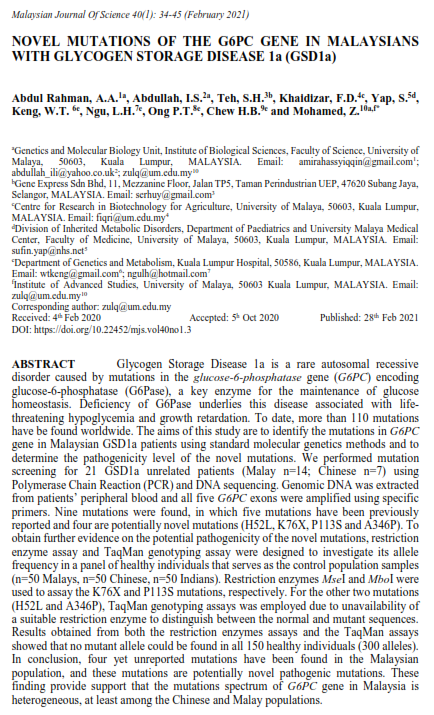
Glycogen Storage Disease 1a is a rare autosomal recessive disorder caused by mutations in the glucose-6-phosphatase gene (G6PC) encoding glucose-6-phosphatase (G6Pase), a key enzyme for the maintenance of glucose homeostasis. Deficiency of G6Pase underlies this disease associated with life-threatening hypoglycemia and growth retardation. To date, more than 110 mutations have be found worldwide.The aims of this study are to identify the mutations in G6PC gene in Malaysian GSD1a patients using standard molecular genetics methods and to determine the pathogenicity level of the novel mutations. We performed mutation screening for 21 GSD1a unrelated patients (Malay n=14; Chinese n=7) using Polymerase Chain Reaction (PCR) and DNA sequencing. Genomic DNA was extracted from patients’ peripheral blood and all five G6PC exons were amplified using specific primers. Nine mutations were found, in which five mutations have been previously reported and four are potentially novel mutations (H52L, K76X, P113S and A346P). To obtain further evidence on the potential pathogenicity of the novel mutations, restriction enzyme assay and TaqMan genotyping assay were designed to investigate its allele frequency in a panel of healthy individuals that serves as the control population samples (n=50 Malays, n=50 Chinese, n=50 Indians). Restriction enzymes MseI and MboI were used to assay the K76X and P113S mutations respectively. For the other two mutations (H52L and A346P), TaqMan genotyping assays was employed due to inavailability of a suitable restriction enzyme to distinguish between the normal and mutant sequences. Results obtained from both the restriction enzymes assays and the TaqMan assays showed that no mutant allele could be found in all 150 healthy individuals (300 alleles). In conclusion, four yet unreported mutations have been found in the Malaysian population, and these mutations are potentially novel pathogenic mutations. These finding provide support that the mutations spectrum of G6PC gene in Malaysia is heterogeneous, at least among the Chinese and Malay populations.
KEY WORDS: Glycogen storage disease type 1a (GSD1a); glucose-6-phosphatase enzyme (G6Pase); Glucose-6-Phosphate catalytic subunit (G6PC).
Downloads
Published
Issue
Section
License
Transfer of Copyrights
- In the event of publication of the manuscript entitled [INSERT MANUSCRIPT TITLE AND REF NO.] in the Malaysian Journal of Science, I hereby transfer copyrights of the manuscript title, abstract and contents to the Malaysian Journal of Science and the Faculty of Science, University of Malaya (as the publisher) for the full legal term of copyright and any renewals thereof throughout the world in any format, and any media for communication.
Conditions of Publication
- I hereby state that this manuscript to be published is an original work, unpublished in any form prior and I have obtained the necessary permission for the reproduction (or am the owner) of any images, illustrations, tables, charts, figures, maps, photographs and other visual materials of whom the copyrights is owned by a third party.
- This manuscript contains no statements that are contradictory to the relevant local and international laws or that infringes on the rights of others.
- I agree to indemnify the Malaysian Journal of Science and the Faculty of Science, University of Malaya (as the publisher) in the event of any claims that arise in regards to the above conditions and assume full liability on the published manuscript.
Reviewer’s Responsibilities
- Reviewers must treat the manuscripts received for reviewing process as confidential. It must not be shown or discussed with others without the authorization from the editor of MJS.
- Reviewers assigned must not have conflicts of interest with respect to the original work, the authors of the article or the research funding.
- Reviewers should judge or evaluate the manuscripts objective as possible. The feedback from the reviewers should be express clearly with supporting arguments.
- If the assigned reviewer considers themselves not able to complete the review of the manuscript, they must communicate with the editor, so that the manuscript could be sent to another suitable reviewer.
Copyright: Rights of the Author(s)
- Effective 2007, it will become the policy of the Malaysian Journal of Science (published by the Faculty of Science, University of Malaya) to obtain copyrights of all manuscripts published. This is to facilitate:
- Protection against copyright infringement of the manuscript through copyright breaches or piracy.
- Timely handling of reproduction requests from authorized third parties that are addressed directly to the Faculty of Science, University of Malaya.
- As the author, you may publish the fore-mentioned manuscript, whole or any part thereof, provided acknowledgement regarding copyright notice and reference to first publication in the Malaysian Journal of Science and Faculty of Science, University of Malaya (as the publishers) are given. You may produce copies of your manuscript, whole or any part thereof, for teaching purposes or to be provided, on individual basis, to fellow researchers.
- You may include the fore-mentioned manuscript, whole or any part thereof, electronically on a secure network at your affiliated institution, provided acknowledgement regarding copyright notice and reference to first publication in the Malaysian Journal of Science and Faculty of Science, University of Malaya (as the publishers) are given.
- You may include the fore-mentioned manuscript, whole or any part thereof, on the World Wide Web, provided acknowledgement regarding copyright notice and reference to first publication in the Malaysian Journal of Science and Faculty of Science, University of Malaya (as the publishers) are given.
- In the event that your manuscript, whole or any part thereof, has been requested to be reproduced, for any purpose or in any form approved by the Malaysian Journal of Science and Faculty of Science, University of Malaya (as the publishers), you will be informed. It is requested that any changes to your contact details (especially e-mail addresses) are made known.
Copyright: Role and responsibility of the Author(s)
- In the event of the manuscript to be published in the Malaysian Journal of Science contains materials copyrighted to others prior, it is the responsibility of current author(s) to obtain written permission from the copyright owner or owners.
- This written permission should be submitted with the proof-copy of the manuscript to be published in the Malaysian Journal of Science
Licensing Policy
Malaysian Journal of Science is an open-access journal that follows the Creative Commons Attribution-Non-commercial 4.0 International License (CC BY-NC 4.0)
CC BY – NC 4.0: Under this licence, the reusers to distribute, remix, alter, and build upon the content in any media or format for non-commercial purposes only, as long as proper acknowledgement is given to the authors of the original work. Please take the time to read the whole licence agreement (https://creativecommons.org/licenses/by-nc/4.0/legalcode ).